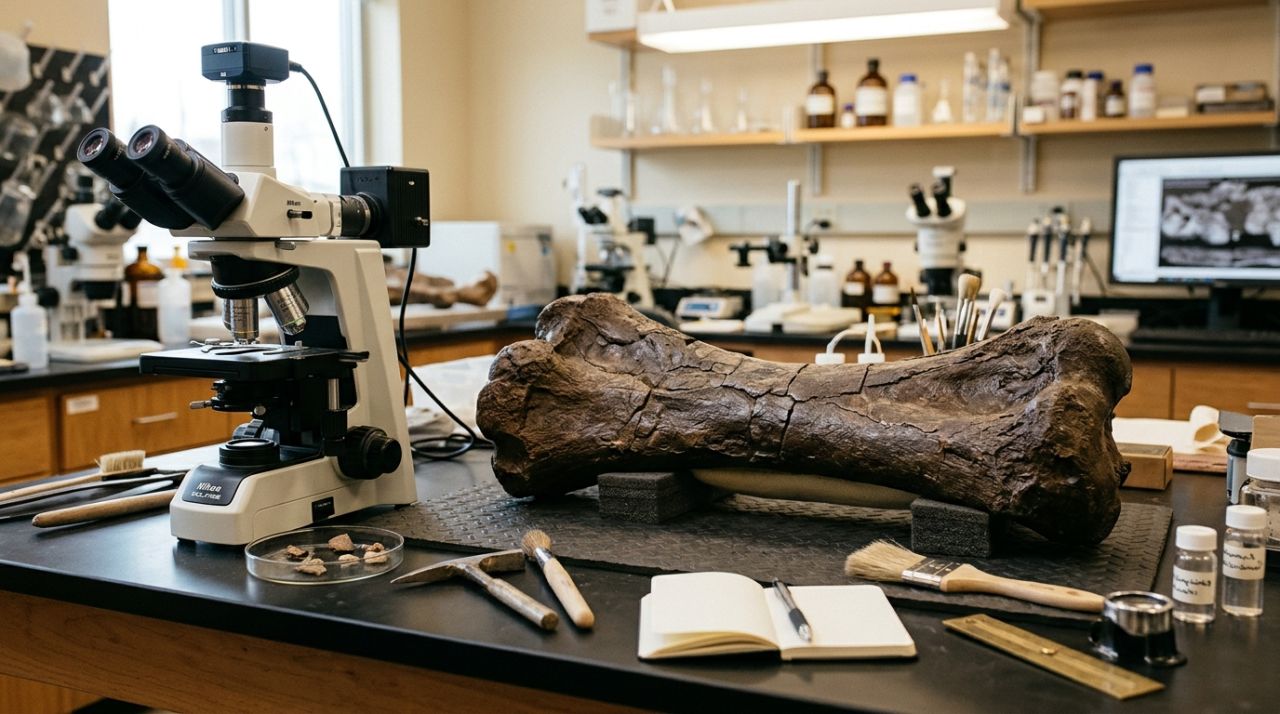
Scientists Identify Heme in a 115-Million-Year-Old Dinosaur Bone, the First Chemical Confirmation
The PNAS study describes a juvenile theropod from Brazil. It is not blood in the usual sense, but molecular traces.
Perth – An international team of palaeontologists in a study published on November 2 in the journal PNAS reported that in a bone of a dinosaur about 115 million years old it chemically identified heme, the iron-containing molecule that carries oxygen and binds to proteins such as hemoglobin. It is the first time heme has been chemically confirmed in a dinosaur, the study states.
The specimen is a juvenile theropod from the Early Cretaceous, Aratasaurus museunacionali, found in 2008 in present-day north-eastern Brazil. It was over three metres long and weighed about 34 kilograms, by the editorial calculation from the source measurements (10 feet and 75 pounds), and because it was young it probably would have grown larger.

In thin sections of the limb bones, the researchers found intact biomolecules and mineralised components of red blood cells. It was also found that the manganese oxide hausmannite helped preserve the cell structures and additional biomolecules, among them amino acids from collagen.
“This really is a landmark discovery,” said chemist Kliti Grice of Australia’s Curtin University, a co-author of the study. “These findings challenge longstanding assumptions that certain biomolecules such as hemoglobin cannot survive deep time.”
How is this possible? The authors theorise that such preservation requires rapid burial in a microbe-rich, low-oxygen environment.
An important limit: these are molecular traces, not intact blood or DNA. Earlier papers already suggested that such preservation is possible, but this is the first study to chemically identify heme.
What is not clear: how applicable this is to other fossils and what it means for the blood, metabolism and activity of dinosaurs. The authors say further research is needed. Possible links to astrobiology are for now speculative.
The authors state that the finding challenges the assumption that hemoglobin cannot withstand deep time, but that additional checks on other specimens are needed.
MKNews Hub · Macedonia · November 9, 2026
